"those shitty little things" and other treasures
finding inspiration among the asters
One of my brothers recently referred to our home as “a house that’s falling apart.” Whatever, John. I know there’s a teetering boulder in the basement holding up half the foundation, but it’s been that way for years. I love our little 1907 home: for its plaster walls, sloping oak floors, mismatching door knobs, and five-panel doors. For its mossy roof and surrounding trees that “terrify” the arborists who came to take a look. For the raccoons in the red oaks, the rabbits in the clover, and the woodpeckers knocking on the shingles. For the orioles, grosbeaks, titmice, chickadees, and gold-shafted northern flickers that bop around the trees and feeder.
The front yard is an overgrown garden on a steepish hill. Scattered with milkweed, ferns, poison ivy, and peonies, it’s home to a few teenage birch trees, an established dogwood, some clethra and yew. Earlier this year, the lily of the valley’s little white bells were so fragrant that the inside of the house smelled like a garden. This plant is prolific: it spreads with rhizomes and seeds, the pretty little bastard. Probably my favorite invasive if I had to choose. We’ll do something about it eventually.
I spent the better part of this summer in and out of the hospital, balancing time with my newborn and time with my toddler. When Muriel finally came home from the ACCU, when the chaos began to subside and I’d stopped peeing my pants, the asters started popping up everywhere.
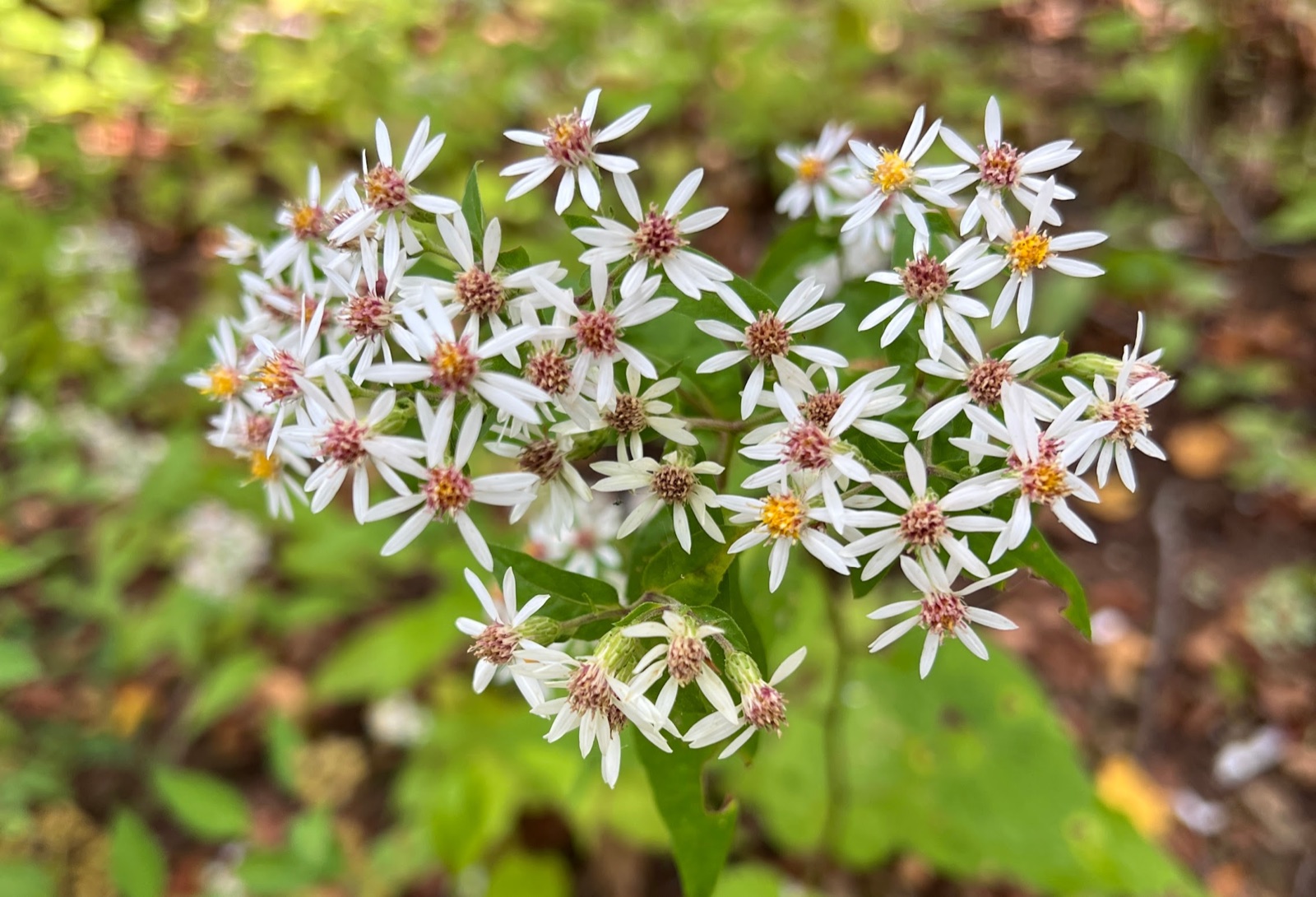
God bless the person–and I do think it was probably a person–who sprinkled generous fistfuls of white wood aster seeds all around the yard. The bright blooms dance on the breeze like corals in the sea, attracting countless bumblebees with their little fall sweaters, bringing exquisite wild laciness to the whole front yard.
Yesterday morning I was gushing about the asters, and how much joy they bring me. “You mean those shitty little things?” asked my husband. I am not usually one to scoff, but I scoffed. Unfortunately, his is an all-too-common sentiment when it comes to native flowers.
Later that morning, after Matt left for work, he texted me. “The asters on the property look awesome. Like an impressionist painting, I love it. Hadn’t been outside in awhile.”
Now that’s more like it. I turned to the Lorax on my shoulder and we did a little dance.
Last summer I was lucky enough to take a three-day native plant class. It made me wish I had formally studied botany–then I’d know more about plants and also exude sexy-supervillain vibes. One of the things I learned was that an aster “flower” is not really a single flower–it’s an inflorescence. An inflorescence is a group of tiny flowers called florets; what looks like an individual aster or daisy or sunflower is actually a combination of ray florets (the structures around the outside that resemble petals), and disk florets (the fertile flowers in the center). Essentially, the sterile but showy ray florets attract the pollinators, and the densely packed disk florets make it possible for the pollinators to visit dozens of individual flowers in a short period, without needing to fly from one flower to the next.
If you’ve noticed that asters have a delightfully snaggletooth quality about them, with petals that don’t follow the perfect symmetry of some other flowers, this is why. The aster’s genes do not create a perfect showy bloom; they skip the fancy-flower-building-process and instead create a bunch of little flowers that work together. It’s a win-win: efficient for both pollinators and the flowers themselves.
Asters have been thriving on this continent for tens of millions of years. Humans have been here for maybe 25,000 years—a blip. When are we going to realize that the whole working-together-thing might be effective? Ray florets and disk florets are wildly different from each other: one long, lean, sterile, smooth, showy and unwieldy; the other round, tubular, densely packed, practical, fuzzy, fertile, dripping with sex… these two little weirdos are an inspiration.
Here’s to you, sweet aster: lace of the forest, hearty and delicate, graceful and strong. A living, photosynthesizing reminder of the importance of teamwork. A picture–nay, an impressionist painting–of survival and success through collaboration. May we all aspire to be as resilient and buoyant as a grove of asters bobbing in the September breeze.